In this lesson
Start on any note of a major scale and take every other scale note until you have four. In C major, start on C and take C, E, G and B. Those four notes form Cmaj7. Start on G and the same process gives G, B, D and F, which form G7.
The Roman numeral names the scale degree of the chord’s root. The chord symbol names the root and quality. In C major, G7 is V7. In G major, Gmaj7 is Imaj7. The F in G7 becomes F♯ in Gmaj7 because those two scales supply different sevenths above G. If you already know how to build triads from a major scale, keep going until you have one more note.
Build the chord on each degree
Say the scale out loud, beginning on the chord’s root. For Cmaj7, say C, D, E, F, G, A, B. Keep the first, third, fifth and seventh notes you say. Then start the count again from the next root. G is scale degree 5 in C major. When building G7, count G as position 1 in the selection. Start G, A, B, then carry on through C, D, E and F in the next C-major octave.
The number after a note name gives its octave. C4 is middle C.
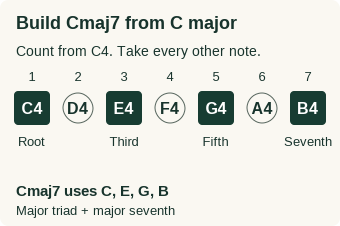
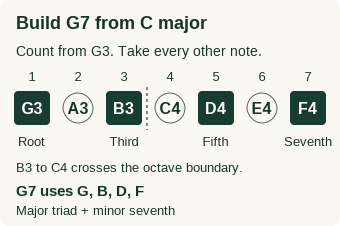
| Chord degree | Notes in C major | Chord symbol | Quality |
|---|---|---|---|
| Imaj7 | C, E, G, B | Cmaj7 | Major seventh |
| ii7 | D, F, A, C | Dm7 | Minor seventh |
| iii7 | E, G, B, D | Em7 | Minor seventh |
| IVmaj7 | F, A, C, E | Fmaj7 | Major seventh |
| V7 | G, B, D, F | G7 | Dominant seventh |
| vi7 | A, C, E, G | Am7 | Minor seventh |
| viiø7 | B, D, F, A | Bm7♭5 | Half-diminished seventh |
A plain 7 in this Roman numeral convention gives a minor seventh above the root. V7 has a major triad and ii7 has a minor triad, as the letter case shows. maj7 specifies a major seventh, and ø7 combines a diminished triad with a minor seventh. In C major, viiø7 combines B–D–F with A.
To identify the interval, count seven letter names from the root, including both ends. Then count the semitones. C up to B is 11 semitones, a major seventh. G up to F is 10 semitones, a minor seventh. Review how seventh chords are built for the triad intervals and more guitar shapes.
Try the same method in G major
Say the G-major scale before you start. Its notes are G, A, B, C, D, E and F♯. Build the chord on D from D, E, F♯, G, A, B, C. The selected notes are D, F♯, A and C, so V7 is D7. Then start on F♯. The four chosen notes are F♯, A, C and E, so viiø7 is F♯m7♭5.
For each remaining scale degree, write the four selected notes in order and name the chord quality. Then open the answer to check your work. The key signatures guide explains why F♯ belongs in G major.
Show the other five chords in G major
- Imaj7 is Gmaj7: G, B, D, F♯. Major seventh.
- ii7 is Am7: A, C, E, G. Minor seventh.
- iii7 is Bm7: B, D, F♯, A. Minor seventh.
- IVmaj7 is Cmaj7: C, E, G, B. Major seventh.
- vi7 is Em7: E, G, B, D. Minor seventh.
Play ii7–V7–Imaj7 in C major
Use standard tuning with no capo. Read each grip from low E to high E. An x asks you to skip that string, and 0 gives an open string.
| Bar | Chord | Grip | Notes in this voicing from bass to treble |
|---|---|---|---|
| 1 | Dm7 | x x 0 2 1 1 |
D3, A3, C4, F4 |
| 2 | G7 | 3 2 0 0 0 1 |
G2, B2, D3, G3, B3, F4 |
| 3 | Cmaj7 | x 3 2 0 0 0 |
C3, E3, G3, B3, E4 |
Start Dm7 on string 4, G7 on string 6 and Cmaj7 on string 5. For Dm7, try using your index finger across the B and high E strings at fret 1 and your middle finger on the G string at fret 2. Pick the intended strings one at a time before strumming each grip.
Set a quarter-note pulse at 60 BPM. Count one bar of four with the guitar quiet, then strum on beat 1 of each playing bar and let the chord ring through beat 4. The player starts with the first chord, so count in yourself before pressing Play. As you move to Cmaj7, stop the low E string from ringing. For one pass, silence the chord on the next 1 after Cmaj7. To repeat, silence both bass strings before strumming Dm7 on that same beat.
Dm7, G7 and Cmaj7: score and practice
Three bars at 60 BPM, one chord on beat 1 of each bar. Count a silent bar before you start. Let each chord ring through beat 4. Stop on the 1 after Cmaj7 for one pass, or strum Dm7 there to repeat.
The score contains 3 played bars at 60 BPM, without a count-in. Follow the lesson's count-in and stopping instructions when you play. The guitar staff uses the usual octave-transposing treble convention; the tab gives the physical string and fret.
The static score is available without loading the player.
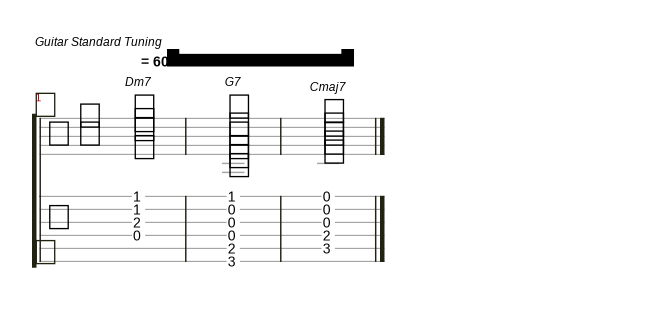
Scroll sideways for the complete score. Interactive notation loads when you ask for it. Practice audio loads separately and starts only after Play. Synthetic audio is a timing reference; it does not check your guitar or replace the instructions for stopping the strings.
Listen to the highest note. In these grips it stays on F for Dm7 and G7, then moves down one fret to E in Cmaj7. The open B string rings in both G7 and Cmaj7. Those details come from the voicings shown here. Other grips can move different voices.
Check your answer
- What seventh do you reach by counting up from C in C major? What seventh do you reach from G in the same key?
- What is V7 in G major, and which note makes its triad major?
- Spell Bm7♭5 in C major. How does its seventh differ from a fully diminished B seventh chord?
Show the worked answers
- Counting from C gives B, a major seventh above C. Counting from G gives F, a minor seventh above G.
- D7 is V7 in G major. F♯ is the major third of the D–F♯–A triad. C is the minor seventh.
- Bm7♭5 contains B, D, F and A. A fully diminished B seventh chord keeps B, D and F and lowers A to A♭.
Sources and next lessons
Robert Hutchinson explains the Roman numeral conventions in Roman Numerals of Diatonic Seventh Chords. Charles Francis Leinberger’s table shows how those numerals depend on the root, chord quality and key. The practice progression and diagrams above are original IGDb examples.
Try cadences on guitar for more ways to hear the end of a phrase. If Bm7♭5 is unfamiliar, compare half-diminished and fully diminished seventh chords.