In this lesson
A Picardy third is the raised third in the major chord that ends music in a minor key. Here the phrase starts in E minor and closes on E major. The root stays E and the last chord changes from E–G–B to E–G♯–B.
Hear the change on the G string
For Em, put your middle finger on A fret 2 and your ring finger on D fret 2. Pick the open G string on its own. Keep those fingers in place, put your index finger on G fret 1, then pick that string again. G♯ makes the chord major. Strum both shapes in turn and listen for that one note among the other five strings.
Use standard tuning. The fret patterns run from low E to high E. Leave out any string marked x and play 0 open. The open-chord lesson shows Em, E major and Am.
| Chord | Frets, low E to high E |
|---|---|
| Em | 0 2 2 0 0 0 |
| Am | x 0 2 2 1 0 |
| B7 | x 2 1 2 0 2 |
| E major | 0 2 2 1 0 0 |
For B7, place your index on D fret 1, middle finger on A fret 2, ring finger on G fret 2 and little finger on high E fret 2. Start the strum on A for both B7 and Am. Start on low E for either E chord.
Play both endings
Set the metronome to 60 BPM and four beats per bar. Keep it visible in a separate window or use another device. Press Start metronome and count a full bar from the higher click.
Strum once on the next 1 and let the chord ring through 4. Change chords on each new 1. As you move from Em to Am, briefly touch low E with your picking hand to stop it ringing. After bar 4, use your picking hand to stop all the strings, including the open ones, on the following 1. Count in again before you play the other ending.
End on Em
Play Em–Am–B7–Em, one chord per bar. Listen for the open G in the last Em.
Em–Am–B7–Em: score and practice
At 60 BPM in 4/4, play one chord on beat 1 of each bar and let it ring through beat 4. Play Em, Am and B7 in the first three bars. End on Em with the G string open in bar 4. Stop the strings on the next beat 1 after bar 4. Count in again before restarting.
The score contains 4 played bars at 60 BPM, without a count-in. Follow the lesson's count-in and stopping instructions when you play. The guitar staff uses the usual octave-transposing treble convention; the tab gives the physical string and fret.
The static score is available without loading the player.
If part of the score is off screen, scroll sideways within the score.
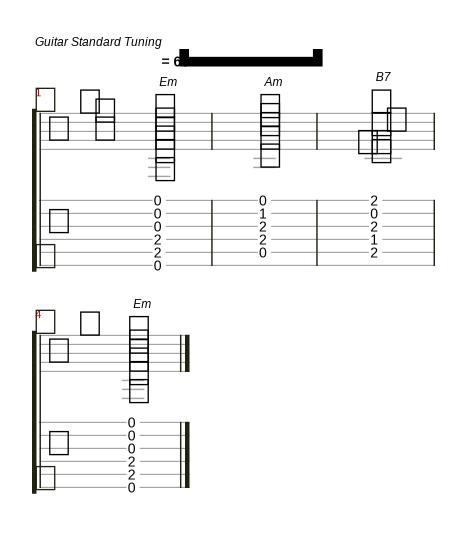
Interactive notation loads when you ask for it. Practice audio loads separately and starts only after Play. Synthetic audio is a timing reference; it does not check your guitar or replace the instructions for stopping the strings.
End on E major
Play Em–Am–B7–E major at the same tempo. On the last chord, listen for G♯ on fret 1 of the G string.
Em–Am–B7–E major: score and practice
At 60 BPM in 4/4, play one chord on beat 1 of each bar and let it ring through beat 4. Play Em, Am and B7 in the first three bars. End on E major, with fret 1 on the G string sounding G sharp in bar 4. Stop the strings on the next beat 1 after bar 4. Count in again before restarting.
The score contains 4 played bars at 60 BPM, without a count-in. Follow the lesson's count-in and stopping instructions when you play. The guitar staff uses the usual octave-transposing treble convention; the tab gives the physical string and fret.
The static score is available without loading the player.
If part of the score is off screen, scroll sideways within the score.
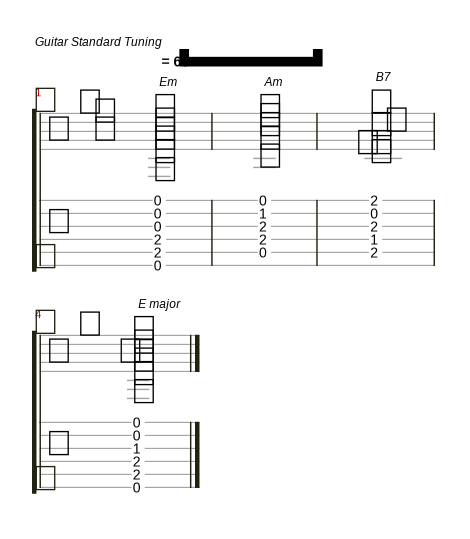
Interactive notation loads when you ask for it. Practice audio loads separately and starts only after Play. Synthetic audio is a timing reference; it does not check your guitar or replace the instructions for stopping the strings.
Why both endings land on E
The first three chords are i, iv and V7 in E minor. The D♯ in B7 sits a semitone below E and leads into either ending. In the second version, raising G to G♯ changes the final i to I. The major chord closes the E-minor phrase.
Check which note changed
Which note in the last chord changes between the scores? What stays the same about B7?
Open G becomes G♯ at fret 1. B7 is the same in both scores, including D♯ on fret 1 of the D string.
Compare relative and parallel minor for another pair of chords that share a tonic. The cadences lesson shows how to locate an ending within the phrase.
John Ito’s cadence lesson includes two examples to compare by ear. Robert Hutchinson describes where the major tonic appears at an ending in minor. IGDb wrote the guitar examples above. Hearing Major and Minor Cadences · The Picardy 3rd