Play G7 into Cmaj7. Now try D♭7 into the same Cmaj7. You can play both dominant chords with the same notes on the D and G strings, so the difference is easy to hear in the bass. In the second version, the bass walks down from D♭ to C.
A tritone substitution replaces a dominant seventh chord with another dominant seventh whose root is six semitones away. That distance is a tritone. Here G and D♭ are a tritone apart, and the substitute root D♭ is one semitone above C.
Why D♭7 can take the place of G7
| Dominant chord | Root | Major third | Perfect fifth | Minor seventh |
|---|---|---|---|---|
| G7 | G | B | D | F |
| D♭7 | D♭ | F | A♭ | C♭ |
The third and seventh are the dominant chord’s guide tones. F is the seventh of G7 and the third of D♭7. B and C♭ are two names for the same sounding pitch on the guitar. G7 spells it B because B is its third. D♭7 spells it C♭ because C♭ is its seventh.
That gives both dominants the same pair of sounding guide tones, with their roles swapped. Changing the root gives you a different way to approach C. In a ii–V–I in C major, you can hear the same substitution in Dm7, D♭7, Cmaj7 in place of Dm7, G7, Cmaj7. The bass then descends D, D♭, C when the three roots are played in the same register.
Play the two endings
Use standard tuning without a capo. Read each grip from low E to high E. An x marks a string to leave silent. These three-note shapes use the root, third and seventh of each chord and leave out the fifth.
| Chord | Grip, strings 6 to 1 | Sounding notes, low to high |
|---|---|---|
| G7 | 3 x 3 4 x x |
G2, F3, B3 |
| D♭7 | x 4 3 4 x x |
D♭3, F3, C♭4 |
| Cmaj7 | x 3 2 4 x x |
C3, E3, B3 |
Start with your fretting index finger on D-string fret 3 and your ring finger on G-string fret 4. Keep both fingers there as you try G7 with your middle finger at low-E fret 3, then D♭7 with that finger at A-string fret 4. For Cmaj7, move the index down to D-string fret 2 and the middle down to A-string fret 3. Keep the ring on G-string fret 4.
Pluck the bass with your picking thumb and the D and G strings with your index and middle fingers. On G7, skip the A string. Try each grip slowly and listen for three clear notes. Dampen the previous bass at each change so it cannot ring under the new chord.
Set a metronome to 60 BPM with four beats per bar. If you use the IGDb metronome, keep it visible beside the lesson or on another device. Count four clicks before you start. Follow the score for four bars. Play G7, Cmaj7, D♭7 and Cmaj7, one chord on the first click of each bar. Pluck all three notes together on 1 and let them ring through 4. Repluck each string in the new grip on the next 1, even when its fret stays the same. To stop, damp the strings on the 1 after the last Cmaj7. To repeat, release Cmaj7 just before that click and play G7 on it.
G7 and D♭7 into Cmaj7: score and practice
Four bars at 60 BPM in 4/4. Play G7, Cmaj7, D♭7 and Cmaj7. Use the grips in the lesson. Pluck all three notes together on beat 1 of each bar and let them ring through beat 4. The bass sequence is G2, C3, D♭3, C3. The D string moves from F3 to E3 in both pairs. The G string stays at fret 4. Damp on the 1 after the final Cmaj7 to stop, or pluck G7 there to repeat.
The score contains 4 played bars at 60 BPM, without a count-in. Follow the lesson's count-in and stopping instructions when you play. The guitar staff uses the usual octave-transposing treble convention; the tab gives the physical string and fret.
The static score is available without loading the player.
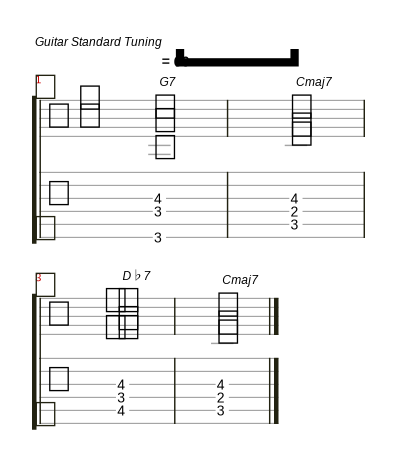
Scroll sideways for the complete score. Interactive notation loads when you ask for it. Practice audio loads separately and starts only after Play. Synthetic audio is a timing reference; it does not check your guitar or replace the instructions for stopping the strings.
The table gives sounding pitches. The standard guitar staff writes them an octave higher.
On your next pass, pluck just the bass notes from each pair. From G2 to C3 the bass rises a fourth in these grips. From D♭3 to C3 it falls a semitone. Then try the D string alone. It goes from fret 3 to fret 2, F to E, in both endings. When you play the full grips again, listen for the top note. You pluck the same pitch in all four bars. Over Cmaj7, that pitch is B, the major seventh.
Check the two guide tones
Which string keeps the same fret through all four bars? What is its note called over D♭7?
The G string stays at fret 4. Over D♭7 it is written C♭, the chord’s seventh. The same fret is written B over G7 and Cmaj7.
When trying the substitution in a tune, check the melody over the replacement chord. A D held over G7 is its fifth. Over D♭7, D can clash with the new bass. D and D♭ are a semitone apart in the same octave. Listen to the chord with the melody in its actual register. For another way to direct attention to a chord, try D7 leading to G as a secondary dominant.
Further reading in Music Theory Online. Michael McClimon describes tritone substitutions in the ii–V–I. Sean R. Smither explains how the two guide tones are preserved. The guitar exercise is IGDb’s own.