In a jazz seventh chord, the third and seventh are called guide tones. Through Am7, D7 and Gmaj7, you can play those two notes on the D and G strings. On the way from Am7 to Gmaj7, each chord change moves one note down a fret. The other note stays where it is. Add the root under each pair to play three shell voicings.
Use standard tuning without a capo. This exercise is in G major, where Am7 is ii7, D7 is V7 and Gmaj7 is Imaj7. The seventh-chord guide explains the chord symbols and the intervals they name.
Find the two notes in each chord
| Chord | D string, string 4 | G string, string 3 |
|---|---|---|
| Am7 | Fret 5, G (minor seventh) | Fret 5, C (minor third) |
| D7 | Fret 4, F♯ (major third) | Fret 5, C (minor seventh) |
| Gmaj7 | Fret 4, F♯ (major seventh) | Fret 4, B (major third) |
Pick the D-string notes on their own: G, F♯, F♯. Next play the G-string notes: C, C, B. The repeated notes change jobs. C is the third of Am7 and the seventh of D7. F♯ is the third of D7 and the seventh of Gmaj7. The path each note takes from chord to chord is called voice leading.
Play the guide tones together
Set a metronome to 60 BPM and four beats per bar. Keep it visible and count an empty bar first. On beat 1 of each bar, pluck the D and G strings together. Let them ring through beat 4. Pick both notes again on the next 1, even when a note stays at the same fret. Keep the other strings quiet.
Am7 to Gmaj7 on two strings: score and practice
At 60 BPM in 4/4, pluck D and G together on beat 1 of each bar. Play frets 5 and 5, then 4 and 5, then 4 and 4. Count all four beats each time. On the 1 after Gmaj7, damp to stop or play the first pair to repeat.
The score contains 3 played bars at 60 BPM, without a count-in. Follow the lesson's count-in and stopping instructions when you play. The guitar staff uses the usual octave-transposing treble convention; the tab gives the physical string and fret.
The static score is available without loading the player.
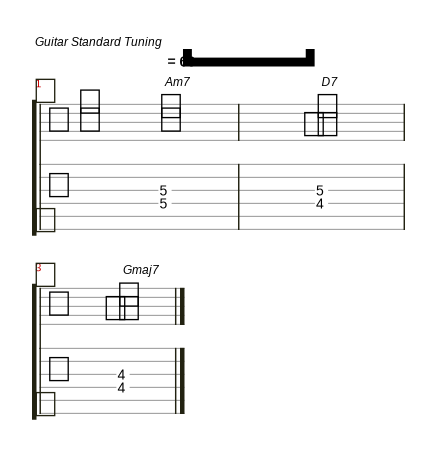
Scroll sideways for the complete score. Interactive notation loads when you ask for it. Practice audio loads separately and starts only after Play. Synthetic audio is a timing reference; it does not check your guitar or replace the instructions for stopping the strings.
The chord labels show where the two notes fit in the progression. The score plays only the pair in each bar. Once you can play both parts together, try following one string by ear through all three bars.
Add a bass note to each pair
These shell voicings use the root, third and seventh of each chord. In this progression the fifth is left out of all three shapes. The two upper notes stay on the same strings and frets as before.
| Chord | Bass note | String and fret |
|---|---|---|
| Am7 | A | String 5 (A), open |
| D7 | D | String 5 (A), fret 5 |
| Gmaj7 | G | String 6 (low E), fret 3 |
Pluck the bass with your thumb, the D string with your index finger and the G string with your middle finger. On Gmaj7, skip the A string between the bass and the D string. For D7, try your fretting index on D-string fret 4, middle on A-string fret 5 and ring on G-string fret 5. For Gmaj7, try your index on low-E fret 3, middle on D-string fret 4 and ring on G-string fret 4. Check the three notes individually before plucking them together. Damp the old bass note at each change so it does not ring under the next chord.
Am7 to Gmaj7 with bass notes: score and practice
Play the same D and G string pairs with a bass note. Add open A on string 5 in bar 1, D on string 5 fret 5 in bar 2 and G on string 6 fret 3 in bar 3. Pick the three notes together on beat 1 of each bar. Leave string 5 silent in bar 3. Damp on the 1 after Gmaj7 to stop, or play Am7 again there.
The score contains 3 played bars at 60 BPM, without a count-in. Follow the lesson's count-in and stopping instructions when you play. The guitar staff uses the usual octave-transposing treble convention; the tab gives the physical string and fret.
The static score is available without loading the player.
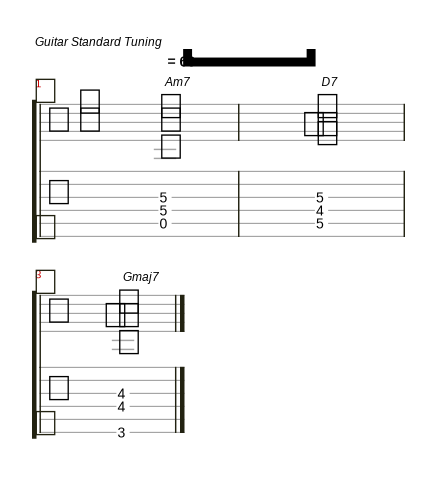
Scroll sideways for the complete score. Interactive notation loads when you ask for it. Practice audio loads separately and starts only after Play. Synthetic audio is a timing reference; it does not check your guitar or replace the instructions for stopping the strings.
Both scores use three bars of four beats, with one attack on each 1. To stop, damp the strings on the 1 after Gmaj7. To repeat, release Gmaj7 just before that click and play Am7 on it. The player’s Repeat this 3-bar score control repeats the music. Count your own empty bar before playing along.
Check which note moves
Which string moves down a fret from Am7 to D7? Which string moves from D7 to Gmaj7?
First the D string moves from fret 5 to fret 4, G to F♯. Then the G string moves from fret 5 to fret 4, C to B.
To find these chords without looking at the tab, build the seventh chords in a major key. To hear similar small movements inside fuller shapes, try the minor ii–V–i lesson.
Further reading: Robert Hutchinson’s guide tones and jazz voicings and Sean R. Smither’s study of guide-tone voice leading. The guitar exercises are IGDb’s own.