In this lesson
A basic shuffle uses a repeating long-short pair within each beat. For the triplet-based model here, count 1 la li: pick on 1 and li, letting the first note continue through la. The numbered beats stay evenly spaced.
You will compare straight eighth notes with that shuffle model on one open string. Each exercise is one bar of 4/4: eight picked notes over four quarter-note beats. The difference is when the second note of each pair starts. This is a timing exercise before adding a blues riff or chord changes.
Keep the beat, move the second attack
Straight eighths split a quarter-note beat in half. Count 1 and 2 and 3 and 4 and, with each “and” halfway between numbers.
For this shuffle model, divide each beat into three equal parts and count the start of each part: 1 la li 2 la li 3 la li 4 la li. Pick on each number and li. There is no new pick on la; the preceding note keeps ringing. The gap from the number to li is twice the gap from li to the next number.
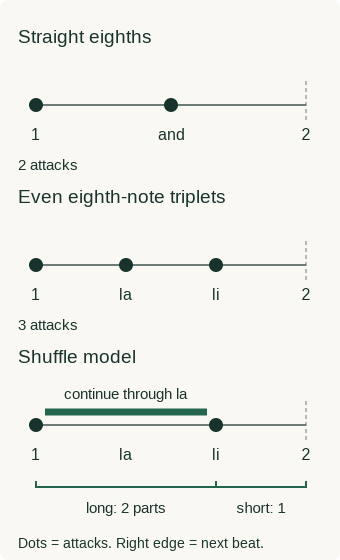
At quarter-note 60 BPM, each numbered beat lasts one second. Straight-note attacks are half a second apart. The shuffle’s attack gaps alternate two-thirds of a second and one-third of a second. Both complete bars still last four seconds, excluding the count-in.
The exact 2:1 spacing gives this exercise a clear target. Swing performances can use different proportions depending on the player, piece and tempo; this model is not a measurement of every swing or shuffle recording.
Set up one string
Use standard tuning, E A D G B E from string 6 to string 1, without a capo. Pick only open string 1, the thin high E, sounding E4 when middle C is called C4. No fretting finger is needed. Keep the other five strings quiet. The tab-reading guide explains the 0 on the top tab line.
Use downstrokes and upstrokes. In playing position, a downstroke passes towards the high-E side and an upstroke towards the low-E side. Review guitar pick strokes if that movement is new. Keep it small enough to control, pause to adjust and stop if playing hurts.
At the metronome, choose four beats per bar and 60 BPM, then press Start. Keep its page visible while using it, or use a separate metronome alongside this lesson. Each click is a numbered quarter-note beat. Count a complete 1 2 3 4 while keeping the guitar quiet, then start on the next 1. The optional players contain only the exercise bar, with no count-in. You can use a slower tempo or work without clicks first.
Exercise 1: play equal pairs
Count 1 and 2 and 3 and 4 and. Pick down on each number and up on each “and”. Keep all eight gaps equal, including the gap from 4-and to the following 1. Let each note ring until the next attack.
Straight eighths: equal pairs: score and practice
Separate one-bar 4/4 exercise at quarter-note 60 BPM. Play only open high E, string 1 fret 0, sounding E4. Count 1 and 2 and 3 and 4 and. Downstroke on each number and upstroke on each and. Eight attacks at half-beat intervals; sustain to each next attack. Four beats, four seconds, no count-in bar. After the last upstroke wait half a beat, then stop on the following 1 without picking; for continuous repetition, pick down there instead. Count a fresh silent bar after a pause. Squared inverted-U means downstroke; V means upstroke.
The score contains 1 played bar at 60 BPM, without a count-in. Follow the lesson's count-in and stopping instructions when you play. The guitar staff uses the usual octave-transposing treble convention; the tab gives the physical string and fret.
The static score is available without loading the player.
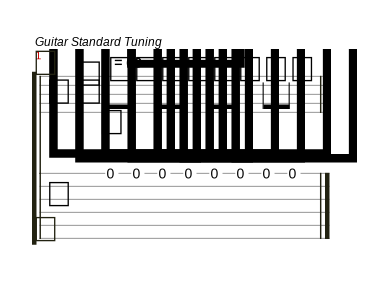
Scroll sideways for the complete score. Interactive notation loads when you ask for it. Practice audio loads separately and starts only after Play. Synthetic audio is a timing reference; it does not check your guitar or replace the instructions for stopping the strings.
After 4-and, wait the remaining half beat. On the following 1, gently touch the high E with your picking hand to stop it, without another pick. That completes one four-beat bar. To repeat continuously, pick down on that 1 instead, without adding a pause or beat. After stopping to adjust, count a fresh silent bar before restarting.
Exercise 2: play long-short pairs
Stop the first exercise. Count a fresh silent bar, then say all twelve positions evenly: 1 la li 2 la li 3 la li 4 la li. Keep the numbers aligned with the clicks.
Each row below is one quarter-note beat. D means downstroke; U means upstroke. “Continue” means no pick and no damping.
| Beat | Count | Actions |
|---|---|---|
| 1 | 1 la li | D, continue, U |
| 2 | 2 la li | D, continue, U |
| 3 | 3 la li | D, continue, U |
| 4 | 4 la li | D, continue, U |
Shuffle model: long-short pairs: score and practice
Separate one-bar 4/4 exercise at quarter-note 60 BPM. Play only open high E, string 1 fret 0, sounding E4. Count 1 la li 2 la li 3 la li 4 la li evenly. Pick down on each number and up on each li. On la the preceding note continues; do not pick or mute. Each triplet group combines a quarter and an eighth: two-thirds plus one-third of a quarter-note beat, no rests or ties. Eight attacks, four beats, four seconds; no count-in bar. After 4-li wait the remaining third of a beat, then stop on the following 1 without picking; for continuous repetition pick down there instead. Count a fresh silent bar after a pause. This exact 2:1 model is not a claim about every swing performance. Squared inverted-U means downstroke; V means upstroke.
The score contains 1 played bar at 60 BPM, without a count-in. Follow the lesson's count-in and stopping instructions when you play. The guitar staff uses the usual octave-transposing treble convention; the tab gives the physical string and fret.
The static score is available without loading the player.
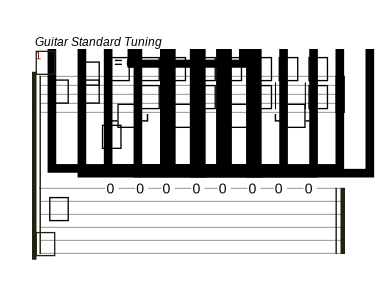
Scroll sideways for the complete score. Interactive notation loads when you ask for it. Practice audio loads separately and starts only after Play. Synthetic audio is a timing reference; it does not check your guitar or replace the instructions for stopping the strings.
Pick down on each number, let that note continue through la, then pick up on li. The next downstroke arrives on the next number. You make two strokes per beat, eight per bar. Do not add a stroke on la to keep your hand moving: this particular exercise alternates down and up on the sounding attacks.
After the last upstroke on 4-li, wait the remaining third of a beat. Stop the string on the following 1 without picking again. For a continuous repeat, pick down on that same 1 instead. Eight attacks end with an upstroke, so the next bar starts down. Keep the short gap across the bar line; do not insert another count. After a pause, stop the string and use a fresh silent count-in.
Read the triplet bracket
The shuffle score shows a quarter note followed by an eighth note within each triplet group marked 3. Here the triplet quarter lasts two-thirds of a normal quarter-note beat and the triplet eighth lasts one-third. Together they fill one beat. The 3 describes the group’s timing, not a requirement to pick three notes.
There are no rests or ties in either exercise. The long note continues across la as one written note. A guitar note naturally fades; another pick would create an extra attack. Rests and ties explains the difference between continuing a sound and stopping it.
The squared inverted-U symbol above a note means downstroke; V means upstroke. The players’ practice sound is synthetic. It can demonstrate the entered timing, but does not show your pick movement or prove how cleanly your guitar is sounding. Loading notation does not start audio; enable practice audio separately, then press Play. Repeat loops the entire one-bar score. Use Stop before changing to the other exercise.
Check the long gap and the short gap
Speak 1 la li evenly before adding the pick. The first note continues across two subdivision lengths, from 1 to li; the second continues across one, from li to 2. Keep that same pattern on beats 2, 3 and 4. Count the middle position even though it has no attack.
If your picks start coming at equal intervals, return to the three spoken positions and place the upstroke only on li. If you accidentally pick three times, leave la unpicked while the first note rings. The even-triplet exercise plays all three positions, giving twelve attacks per bar; this shuffle model plays eight.
Do not replace the long-short pair with a dotted eighth plus a sixteenth. Those ordinary dotted values divide a beat 3:1, while this exercise uses 2:1. Dots and ties explains the dotted-note calculation.
Palm muting is a separate choice about the sound’s length and tone. It is not required for these sustained one-string examples. Once the timing is steady, the twelve-bar blues lesson gives you a chord form to learn separately: twelve bars describe the form, while shuffle describes subdivision and feel. Its one-strum-per-bar score does not add this shuffle pattern automatically.
For a comparison, keep the same metronome setting. Play one bar of equal pairs, stop, then use a fresh count-in for one bar of long-short pairs. Listen for the later upstroke in the shuffle and its shorter gap to the next downstroke.
Check your understanding
- Where are the two attacks inside
1 la li? - What happens to the sounding note on
la? - How many attacks and quarter-note beats fill either exercise bar?
- At quarter-note 60 BPM, how long does one bar take?
- Does the triplet 3 require three picked notes in the shuffle group?
- After 4-li, when do you stop, or begin a continuous repeat?
Check your answers
- On
1andli: down, then up. The next number gets a downstroke. - It continues ringing without another pick or damping.
- Eight attacks over four quarter-note beats. The ordinary eighths are equally spaced; the shuffle attacks alternate long and short gaps.
- Four seconds, excluding the manual count-in. Changing subdivision does not change the beat’s speed.
- No. A triplet quarter and triplet eighth fill the beat with two attacks, lasting two-thirds and one-third of that beat.
- Wait the remaining third of a beat. On the following 1, touch the string to finish without another pick, or pick down there to repeat without an extra beat.
Sources
Megan Lavengood’s Swing rhythms in Open Music Theory explains unequal eighths and variation in swing proportions (written text CC BY-SA 4.0). Berklee Online’s Funk and rock drum rhythms, excerpted from Larry Finn’s book, describes the usual triplet basis of shuffle. Andy Guitar’s written Blues shuffle and swing strumming provides a guitar example with different articulation. This lesson keeps the middle subdivision sustained rather than adopting that muted example.
The straight exercise repeats the equal-pair control from our triplet lesson so you can compare it here with the long-short model. The timing diagram, shuffle score and practice instructions were prepared for IGDb. No external song, recording, score or artwork is reproduced. Read how we write our guitar lessons for how IGDb researches and checks examples.