In this lesson
Play C, F, F minor and C. The F minor chord is the borrowed minor iv in C major. Its root is still F, scale degree 4. The A in F major drops to A♭, a note from C minor, then the line drops another semitone to G in the final C chord. On the G string you can play that line at frets 2, 1 and 0.
C major and C minor share the same tonic. C minor is the parallel minor of C major. In this example the F minor chord comes from the parallel minor while the progression still starts and ends on C major. This is one kind of modal mixture, also called modal borrowing.
Change the third of F
Build a triad on scale degree 4 in C major and you get F major. Build it on the same degree in C natural minor and you get F minor. Both start on F.
| Chord in the progression | Notes | What to listen for |
|---|---|---|
| F, IV | F–A–C | A, the major third of F |
| Fm, iv | F–A♭–C | A♭, the minor third of F |
| C, I | C–E–G | G, one semitone below A♭ |
A♭ is the lowered sixth degree of C. It is also the third of F minor. Those two descriptions count from different starting notes. Use lower-case iv for the minor chord. The root of the chord is still the fourth degree, so the numeral has no flat sign before it. For the scale method, see chords in a major key and chords in a minor key.
Hear the difference on guitar
Use standard tuning without a capo. The shapes run from the thickest to the thinnest string. An x marks a string to skip and 0 means open.
| Chord | Shape | Sounding strings, low to high |
|---|---|---|
| C | x 3 2 0 1 0 |
C3, E3, G3, C4, E4 |
| F | x x 3 2 1 1 |
F3, A3, C4, F4 |
| Fm | x x 3 1 1 1 |
F3, A♭3, C4, F4 |
On F, fret the B and high E strings at fret 1 with your index finger. Add middle finger at G-string fret 2 and ring finger at D-string fret 3. For Fm, move your index finger across the three thinnest strings at fret 1 and lift your middle finger. Keep the ring finger at D-string fret 3. Pick the upper four strings individually before trying a chord. If the small barre takes time, start by playing G-string frets 2, 1 and 0 on their own.
Play both versions with the same count, one chord per bar. At 60 BPM you have about a second per beat. Count four beats before you start. Strum on beat 1 of each bar and let the chord ring through beat 4. Mute on the next 1 after the final C, or strum the first C there to repeat.
C–F–F–C
Play F again in the third bar. The G string stays on fret 2 for both F chords before it opens for the final C.
C, F, F and C: score and practice
Four bars at 60 BPM. Count in four beats, then strum each chord on beat 1 and let it ring through beat 4. Stop on the next 1 or start at C again.
The score contains 4 played bars at 60 BPM, without a count-in. Follow the lesson's count-in and stopping instructions when you play. The guitar staff uses the usual octave-transposing treble convention; the tab gives the physical string and fret.
The static score is available without loading the player.
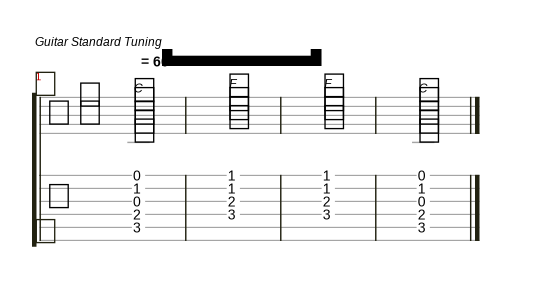
Scroll sideways for the complete score. Interactive notation loads when you ask for it. Practice audio loads separately and starts only after Play. Synthetic audio is a timing reference; it does not check your guitar or replace the instructions for stopping the strings.
C–F–Fm–C
This time change just the fretted G string in the third bar, from fret 2 to fret 1. The other sounded notes of F stay in place. Hear the G string move A–A♭–G across bars 2, 3 and 4.
C, F, Fm and C: score and practice
Use the same count as the all-major version. In the third bar, move the G string from fret 2 to fret 1. Let the open G string ring in the final C chord. Stop on the next 1 or start at C again.
The score contains 4 played bars at 60 BPM, without a count-in. Follow the lesson's count-in and stopping instructions when you play. The guitar staff uses the usual octave-transposing treble convention; the tab gives the physical string and fret.
The static score is available without loading the player.
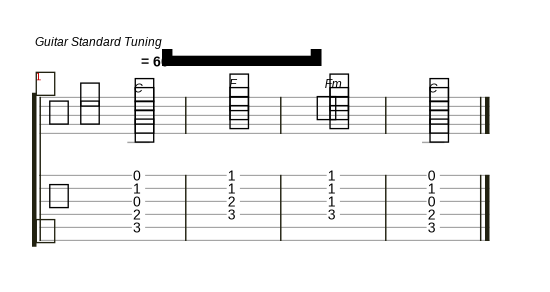
Scroll sideways for the complete score. Interactive notation loads when you ask for it. Practice audio loads separately and starts only after Play. Synthetic audio is a timing reference; it does not check your guitar or replace the instructions for stopping the strings.
The borrowed version ends with the plagal motion from iv to I. Compare Fm–C with the F–C ending in the cadences lesson.
Try the same change in G major
The fourth chord in G major is C major. Lower its third by a semitone, then find the note one more semitone down. Play the three notes on the B string at frets 5, 4 and 3.
Check the chords and the notes
The chords are C, Cm and G. The B-string line is E, E♭ and D. E♭ is the lowered sixth of G and the minor third of C. D is the fifth of the final G chord.
For more on parallel-minor borrowing and the Roman numerals, see Mode Mixture by Robert Hutchinson and Modal Mixture in Open Music Theory.