In this lesson
The circle of fifths arranges key names by perfect fifths. Start at C and move clockwise to G, D, A and E. For major keys, each step along that sharp-key sequence adds one sharp to the key signature. Moving the other way from C gives F, B♭, E♭ and A♭, adding one flat per step.
On guitar, you can use the chart to find a key signature and the roots of a major key’s I, IV and V chords. The circle does not tell you a fingering, rhythm or which key a song must be in. This lesson starts with written tasks; the optional playing check uses familiar open G, C and D shapes.
Why a fifth takes you from C to G
Count letter names including both ends: C, D, E, F, G gives five. C up to G is a perfect fifth, spanning seven semitones. On string 2 in standard tuning, C4 at fret 1 and G4 at fret 8 are seven fret steps apart. These octave numbers name sounding pitches, with middle C called C4.
The circle is a map of note names, without fixed octaves. Clockwise C to G can be played as an ascending fifth; counterclockwise C to F can be played as a descending fifth or an ascending fourth. C up to F is five semitones, so moving left is not an instruction to go up seven frets. The interval reference explains the letter-count and semitone checks.
Read the major-key circle
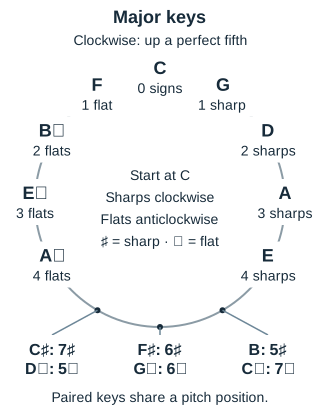
Starting from C, the sharp-key route is C: no signs; G: 1 sharp; D: 2; A: 3; E: 4; B: 5; F♯: 6; C♯: 7 sharps.
Starting again from C, the flat-key route is C: no signs; F: 1 flat; B♭: 2; E♭: 3; A♭: 4; D♭: 5; G♭: 6; C♭: 7 flats.
The two routes overlap at three positions: B/C♭, F♯/G♭ and C♯/D♭. Each pair has the same pitches on an ordinary equal-tempered guitar, with different spellings and signatures. B major has five sharps; C♭ major has seven flats. The circle therefore shows twelve pitch-class positions and fifteen conventional major-key spellings. After C♯, this chart switches to the easier flat spelling A♭; continuing to G♯ major would require a double sharp.
Work out which notes are sharp or flat
The count tells you how many signs to take from a fixed order:
- Sharps: F♯, C♯, G♯, D♯, A♯, E♯, B♯.
- Flats: B♭, E♭, A♭, D♭, G♭, C♭, F♭.
For D major, go two steps clockwise from C: C, G, D. Take the first two sharps, F♯ and C♯. The scale is D, E, F♯, G, A, B, C♯, D.
For B♭ major, go two steps counterclockwise: C, F, B♭. Take B♭ and E♭. The scale is B♭, C, D, E♭, F, G, A, B♭. B♭ is the name of the tonic as well as one of the signature’s altered notes.
Count moves away from C, with C as zero. These signature counts apply to the major-key names on this chart; B minor does not use B major’s five-sharp signature. The key-signature reference covers staff placement, local accidentals and all the major/minor pairs.
Find the relative minor
A major key and its relative minor share a key signature. Find degree 6 of the major scale, or go three semitones down from its tonic:
| Major key on the circle | Signature | Relative minor |
|---|---|---|
| C major | No sharps or flats | A minor |
| G major | F♯ | E minor |
| D major | F♯, C♯ | B minor |
| B♭ major | B♭, E♭ | G minor |
For D major, count D, E, F♯, G, A, B. Its sixth degree gives B minor. Keep the spelling consistent: D♭ major’s relative minor is B♭ minor, not A♯ minor. Minor music may raise scale notes with local accidentals while retaining its basic signature.
A signature alone does not establish a piece’s tonic. For example, one sharp can occur in G major or E minor, and modal music can share the same signature. Use the melody and harmony in context. Relative and parallel minor explains why a shared signature differs from a shared tonic.
Find I, IV and V around a major tonic
Choose a major key. Its tonic is I. The adjacent pitch position counterclockwise gives the root of IV; the adjacent pitch position clockwise gives the root of V. All three are major triads in a major key. Spell each root using the chosen major scale, including at the chart’s enharmonic joins.
For example, C♯ major’s V is G♯ major, even though the next position on this compact chart is labelled A♭. C♭ major’s IV is F♭ major, although that neighbouring position is labelled E. Those alternate names share frets in equal temperament, but G♯ and F♭ preserve the scale-degree spellings in these keys. The worked G- and D-major examples below need no respelling.
For G major, the neighbouring names are C, G and D:
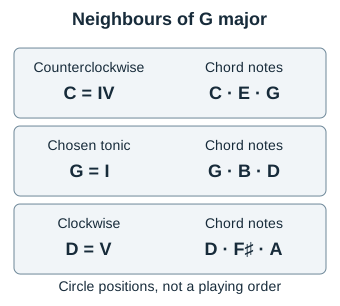
Check against the G-major scale, G, A, B, C, D, E, F♯. Its first, fourth and fifth degrees are G, C and D. Their triads are G–B–D, C–E–G and D–F♯–A.
Try D major next: G is the counterclockwise neighbour and A the clockwise neighbour. I, IV and V are D, G and A. Their notes are D–F♯–A, G–B–D and A–C♯–E, all from D major’s scale. The major-key chord lesson shows how to build all seven triads, rather than only these three.
This shortcut gives chord-root positions and major qualities for the stated major key; check their names against its scale. It does not turn every name around the circle into a chord belonging to that key. It also does not prescribe the order IV–I–V: you can arrange those chords in different progressions. For changing a whole chart’s key, follow the transposition method and preserve every chord type and named bass.
Check G, C and D on guitar
Use standard tuning, E A D G B E from string 6 to string 1, with no capo. Read each pattern from low E to high E: x means leave that string out; 0 means open. Small numbers in the dots are fretting fingers. The first-chord lesson gives full finger placement.
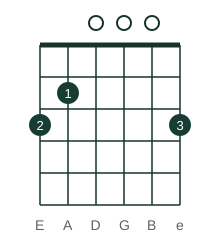
3 2 0 0 0 3.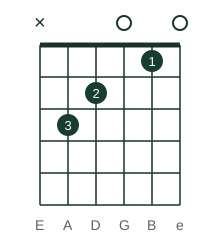
x 3 2 0 1 0.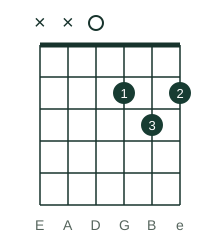
x x 0 2 3 2.| Chord | Strings to check separately | Sounding pitches, low to high |
|---|---|---|
G: 3 2 0 0 0 3 |
All six | G2, B2, D3, G3, B3, G4 |
C: x 3 2 0 1 0 |
A through high E | C3, E3, G3, C4, E4 |
D: x x 0 2 3 2 |
D through high E | D3, A3, D4, F♯4 |
Form G and pick its six strings separately, from low to high. Stop the ringing strings, take time to form C, then pick its five intended strings. Stop again, form D and pick its four intended strings. Finish by gently touching the strings to stop them. To repeat, form G again and restart the same untimed check. There is no beat, strumming pattern or playback to match here; stop if playing hurts.
The repeated notes in a grip do not change its chord type. For example, G’s six strings still contain only the three note names G, B and D. When you want a steady count, use the counted I–IV–V–I exercise after checking these shapes slowly.
What the circle does not decide
The key-signature circle is not the same as a circle-of-fifths chord progression. A progression can follow descending fifths through the chords of one key; its chord qualities and intervals need their own check. Travelling through all the major-key names is not a list of chords that all belong to one key.
Nor does the chart establish a song’s key from its first chord, choose a comfortable singing range, or supply guitar fingerings. Use it to answer a specific question: a signature count, a relative-key relationship, or the I/IV/V roots of an already stated major key.
Check your understanding
- How many sharps does A major have, and which notes are sharp?
- Which major key is two counterclockwise steps from C?
- What is D major’s relative minor?
- In D major, which chords are IV and V?
- Why do B major and C♭ major occupy one position but have different counts?
- Does a one-sharp signature prove that a piece is in G major?
Check your answers
- Three: F♯, C♯ and G♯.
- B♭ major, with B♭ and E♭ in its signature.
- B minor. Both signatures use F♯ and C♯.
- G major and A major. Their roots are one position counterclockwise and clockwise from D.
- They are enharmonic spellings with the same pitches in equal temperament. B major uses five sharps; C♭ major uses seven flats.
- No. E minor and modal contexts can share that signature; the melody and harmony must establish the tonic.
Sources and next steps
Robert Hutchinson’s Major key signatures explains the circle’s direction and overlapping spellings; his Circle of fifths progression distinguishes the key-signature chart from a diatonic harmonic progression. His major-key chord reference gives the major/minor/diminished triad pattern. Chelsey Hamm and Bryn Hughes’s Open Music Theory chapters on major keys and minor keys support signature order and relative-key spelling (CC BY-SA 4.0). The diagrams, guitar pitch checks and questions here were prepared for IGDb; no source artwork, music or recording is reproduced.
Use the key-signature reference when reading staff notation, or build the full major-key chord family to find the minor and diminished chords between I, IV and V.