In C major, Fm7–B♭7–Cmaj7 is a backdoor cadence. The bass rises from B♭ to C in the final change. At the same time, the high E string goes from fret 1 to open E, and its note falls from F to E. Try those two strings on their own before playing the whole chords.
Where the first two chords come from
C minor is the parallel minor of C major. Fm7 and B♭7 use notes from C natural minor. Cmaj7 brings the phrase back to C major.
| Chord | In C | Chord tones |
|---|---|---|
| Fm7 | iv7 | F, A♭, C, E♭ |
| B♭7 | ♭VII7 | B♭, D, F, A♭ |
| Cmaj7 | Imaj7 | C, E, G, B |
♭VII7 is a dominant seventh chord built on the lowered seventh degree. In C major that gives B♭7, whose bass lies a whole step below C. In the usual G7-to-C cadence, the approach chord starts on G, the fifth degree of C.
In E♭ major, Fm7–B♭7–E♭maj7 is ii7–V7–Imaj7. The first two chords are the same in both examples. In the backdoor phrase below, they lead back to Cmaj7, the chord you started on.
Hear two lines in the last change
Use standard tuning, E–A–D–G–B–E from low to high, with no capo. Play fret 1 on the A string, then fret 3 on the same string. That’s B♭ to C. On the high E string, play fret 1 and then the open string. That’s F to E. If you’re comfortable with a first-fret barre, hold B♭ and F with it. Pluck A and high E together with your picking-hand thumb and middle finger. Lift the barre, fret A at 3 and pluck the pair again with high E open. Listen for the gap between the two notes getting smaller.
Play the four-bar phrase
Read the frets and sounding notes from low E to high E. An x marks a string to skip. A 0 means open.
| Chord | Frets | Notes |
|---|---|---|
| Cmaj7 | x 3 2 0 0 0 |
C3, E3, G3, B3, E4 |
| Fm7 | 1 3 1 1 1 1 |
F2, C3, E♭3, A♭3, C4, F4 |
| B♭7 | x 1 3 1 3 1 |
B♭2, F3, A♭3, D4, F4 |
- For Cmaj7, fret A at 3 with your ring finger and D at 2 with your middle finger. G, B and high E ring open. Start the stroke on A.
- For Fm7, leave your ring finger on A at fret 3. Lift your middle finger and barre all six strings at fret 1 with your index finger.
- For B♭7, keep the barre on strings 5 through 1. Move your ring finger to D at fret 3 and put your little finger on B at fret 3. Touch low E with the side of your picking hand to stop the old low F before you strum from A.
- For the last Cmaj7, lift the barre and your little finger so G, B and high E can ring open. Return your ring finger to fret 3 on A and your middle finger to fret 2 on D. Strum from A.
Work through the grips without a beat, then set a metronome to 60 BPM with four beats per bar. Keep it visible in a separate window or on another device while you follow the score. Press Start and count four clicks from the higher click on beat 1. Downstrum Cmaj7, Fm7, B♭7 and Cmaj7, one chord on each beat 1. Let each chord ring through beat 4. On the next 1 after the last Cmaj7, touch all five sounding strings to stop them, including the three open strings. For another round, keep the grip and strum Cmaj7 again on that beat.
Cmaj7, Fm7, B♭7 and Cmaj7: score and practice
Play one downstroke on beat 1 of each bar in 4/4 at 60 BPM. Start on Cmaj7, then play Fm7, B♭7 and Cmaj7. Strum from A for both Cmaj7 chords. Fm7 uses all six strings. Stop low E before you strum B♭7 from A. On the last change, lift the barre so high E can ring open. Finish by damping all five sounding strings on the following 1, or strum Cmaj7 again there to repeat.
The score contains 4 played bars at 60 BPM, without a count-in. Follow the lesson's count-in and stopping instructions when you play. The guitar staff uses the usual octave-transposing treble convention; the tab gives the physical string and fret.
The static score is available without loading the player.
If part of the score is off screen, scroll sideways within the score.
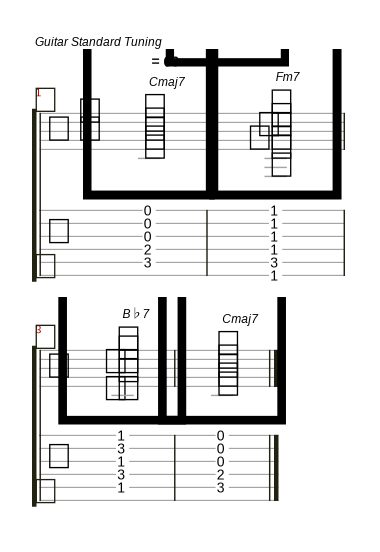
Interactive notation loads when you ask for it. Practice audio loads separately and starts only after Play. Synthetic audio is a timing reference; it does not check your guitar or replace the instructions for stopping the strings.
Play bars 3 and 4. Listen to the lowest and highest notes and say which one went up before you open the answer. If the top note stays on F, check your first-fret barre.
Check the direction of each line
The bass goes up from B♭ to C. The top note goes down from F to E. If high E stays on F, release your index finger from fret 1 and pick the open string on its own. The G string also falls, from A♭ at fret 1 to open G.
Try Fm straight into C to hear the borrowed minor chord without B♭7 between them. D♭7 to Cmaj7 is another approach to the same chord. D♭7 is a tritone substitute for G7, and its bass falls a semitone to C.
The “Backdoor Turnaround” in Jazz Guitar Chord Turnarounds starts and ends on Cmaj7 with Fm7 and B♭7 in between. Niels Dalgaard’s backdoor progression lesson explains the parallel-minor chords and the connection to E♭. The frets and counting exercise above are IGDb’s.