To make a drop-2 voicing, start with four chord tones in close position. Find the second-highest note and move it down one octave. Start with this close, root-position Cmaj7. From low to high, it has C3, E3, G3 and B3. G3 is second from the top. Move it to G2 and leave C3, E3 and B3 at the same pitches.
A voicing is the arrangement of the pitches in a chord. In this close voicing, all four fit inside one octave. The drop-2 version spreads them out. The notes are still C, E, G and B. G is now the lowest. The slash symbol in Cmaj7/G specifies that G bass. See how seventh chords are built and what slash chords tell you.
Compare the two grips
Use standard tuning without a capo. The fret patterns run from string 6 to string 1. A zero means open and x means leave the string silent. C4 is middle C.
| Voicing | Frets, low E to high E | Sounding pitches, low to high |
|---|---|---|
| Close Cmaj7 | x 3 2 0 0 x | C3, E3, G3, B3 |
| Drop-2 Cmaj7/G | 3 3 2 4 x x | G2, C3, E3, B3 |
For the close grip, try your ring finger on A-string fret 3 and your index on D-string fret 2. The G and B strings are open. Keep ring and index where they are for the drop-2 grip. Add middle on low-E fret 3 and little finger on G-string fret 4. Check each string before playing all four. Leave the B and high E strings quiet in the drop-2 grip.
C3 and E3 keep their original string and fret. The highest note is B3 in both grips. It moves from the open B string to fret 4 on the G string, so your hand changes even though that pitch stays the same.
Pick the notes, then play the full chords
Set a metronome to 80 BPM and four beats per bar. Keep it visible. Count four quiet clicks, then play the four bars below.
- Pick the close Cmaj7 notes in order from low to high, one note on each click.
- Pick the drop-2 notes in order from low to high, one note on each click.
- Play the four close-position notes together on 1. Let the chord ring through beat 4.
- Play the four drop-2 notes together on 1. Let the chord ring through beat 4.
For the first two bars, stop each note as the next one sounds so you can hear the order. For the full chords, pluck all four with your fingers or make one gentle sweep across just those strings. As you change to bar 4, touch the open B string to stop it ringing. Try resting the side of your fretting little finger against it while you fret the G string. Listen for the same high B against the lower G in the last bar. If the change makes you miss a click, practise the two grips without the metronome, then try a slower pulse.
Close Cmaj7 and drop-2 Cmaj7: score and practice
At 80 BPM in 4/4, pick C3, E3, G3 and B3 from low to high in bar 1, one note per click. In bar 2 pick G2, C3, E3 and B3. For bars 3 and 4 play the four notes together on 1, letting each chord ring through 4. Use the fret table for both grips. Damp on the 1 after bar 4 to stop, or pick C3 there to repeat.
The score contains 4 played bars at 80 BPM, without a count-in. Follow the lesson's count-in and stopping instructions when you play. The guitar staff uses the usual octave-transposing treble convention; the tab gives the physical string and fret.
The static score is available without loading the player.
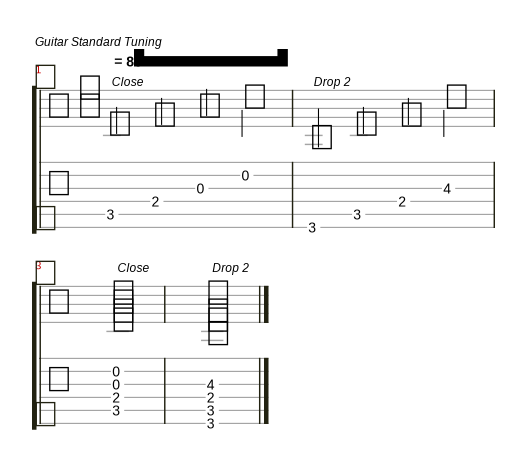
Scroll sideways for the complete score. Interactive notation loads when you ask for it. Practice audio loads separately and starts only after Play. Synthetic audio is a timing reference; it does not check your guitar or replace the instructions for stopping the strings.
On the 1 after bar 4, damp the strings to stop. To repeat, damp the chord as you change grips and pick the low note of the close voicing on that click. The player’s Repeat this 4-bar score control returns to the first note without adding a count-in bar.
Check which note moves
Which note drops by an octave? Which note stays highest, and where do you play it in the drop-2 grip?
G3 drops to G2. B3 stays highest. In the drop-2 grip it is on string 3 at fret 4.
Dropping a note can change the bass and the inversion. In this example the fifth becomes the bass, giving second inversion. Practise finding inversions of three-note guitar chords for another way to shift the bass. To follow two pitches through several chords, try guide tones and shell voicings.
Further reading: Berklee Online’s Voice Leading for Guitar describes the guitar application. Mel Bay’s description of Charles H. Chapman’s Drop-2 Concept for Guitar gives the octave-drop rule. The practice score is IGDb’s own.